
Every child.
Every school.
Every opportunity.
Vision
An Australian school system where every child, in every school, has a fair go and the opportunity to thrive.
Mission
We bring Australians together to build public support and policy change for a fairer, world-class school system where every child has the opportunity to thrive.
What we believe
-
We are inviting Australians to work together on practical solutions that balance fairness, choice and opportunity. To guide this conversation, we have set out a series of foundational, common-sense principles aimed at balancing choice with fairness.
-
Australia has one of the most socially segregated school systems in the OECD. Growing concentrations of social advantage and disadvantage are contributing to widening educational gaps and placing increasing pressure on schools and communities.
Debate about reform is often framed as a contest between equity and excellence, or fairness and choice. Yet many high-performing education systems demonstrate that these goals can be pursued together.
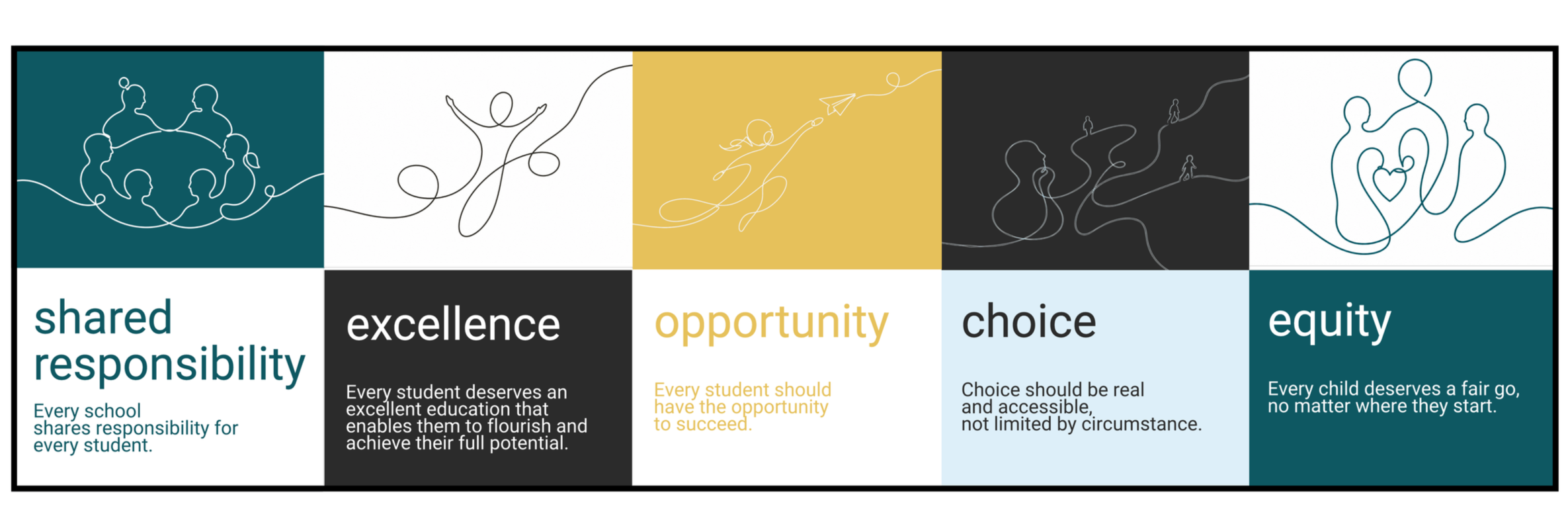
We believe Australia can create a stronger school system that combines equity, choice, opportunity and excellence — ensuring every child has access to a fair go and the opportunity to thrive.
-
Commensurate Public Obligations: All schools that receive public funding should face commensurate public obligations.
An Inclusive Regulatory Environment: We believe a common regulatory environment should ensure that every publicly funded school is inclusive, accessible, and welcoming. Our settings should actively support socio-economic diversity across the entire school system and work to minimise intense concentrations of either privilege or disadvantage.
Fair Fee Regulation: To ensure true accessibility, public funding must mean that a school's capacity to charge compulsory fees is either appropriately regulated or prohibited.
Needs-Based Funding for All: All schools should be resourced entirely on the basis of educational need. Non-government schools that choose to operate without charging fees should receive full public funding to meet their recurrent and capital costs.
-
Preserving Autonomy and Mission: Non-government schools must continue to have the freedom to promote their specific religious or educational ethos. They will maintain the same autonomy over their curriculum and ethos as they have today, including a sensible carve-out that allows them to prioritise enrolments according to their defined mission.
Genuine Choice: Non-government schools that prefer to operate completely outside of this common funding and regulatory framework are entirely free to do so, continuing their operations independently without public subsidies.
-
We believe there are many practical mechanisms for promoting socio-economic diversity and ensuring shared responsibility for all students. We want to explore how these proven international ideas can best be adapted to the Australian context. Around the world, school systems have demonstrated the success of policies like reserved quotas for disadvantaged students, socioeconomic status-weighted lotteries for out-of-area applications, or fairer zoning guidelines across school sectors. We need a new national conversation about what will work in the Australian context.